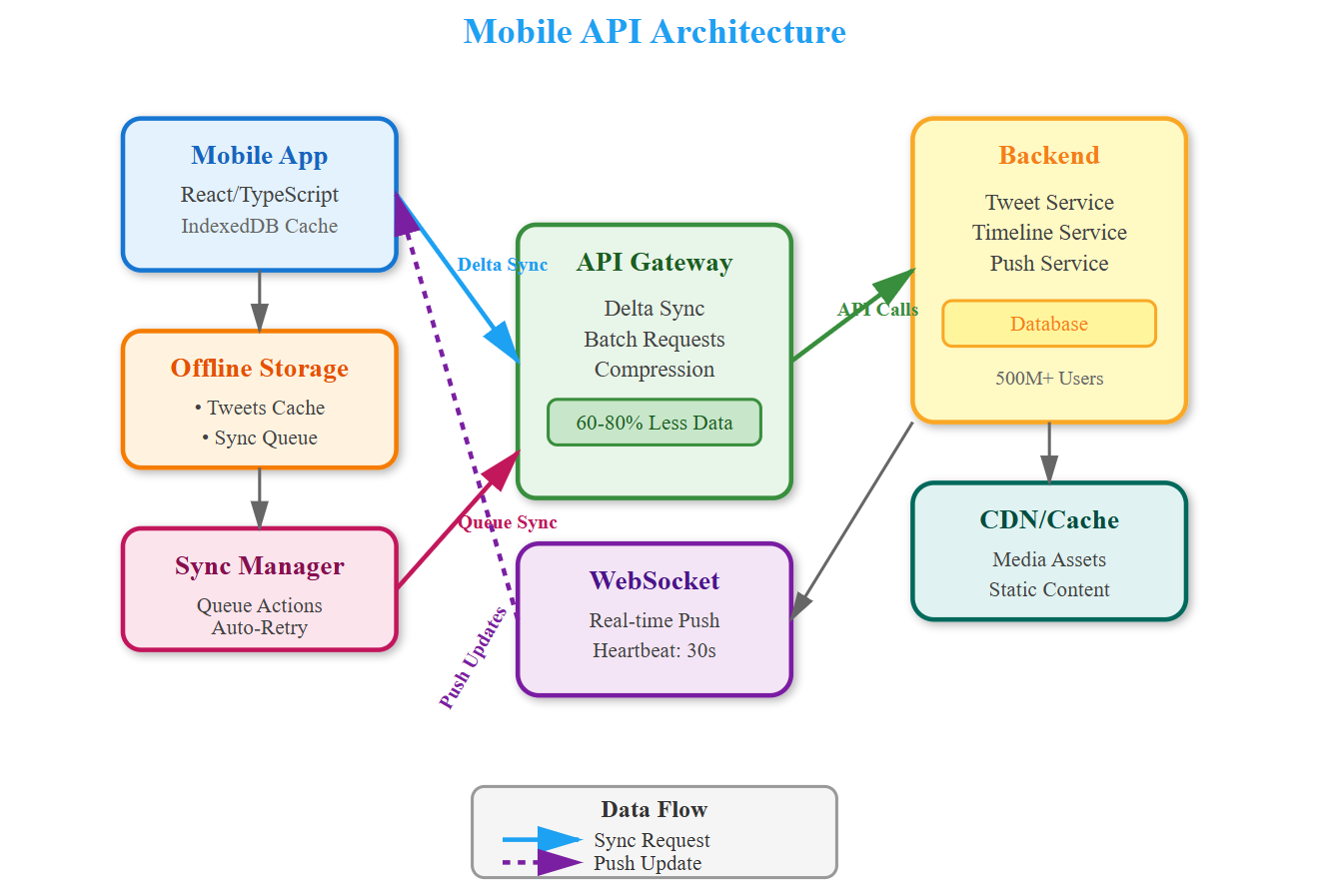
Lesson 34: Mobile API Optimization - Building Mobile-First Social Networks

What We’re Building Today
You’re about to transform your Twitter clone into a mobile powerhouse. Today’s lesson tackles the brutal reality: mobile users represent 80% of social media traffic, yet face constraints that desktop users never experience—limited bandwidth, battery drain, unreliable connectivity, and data caps.
We’ll engineer three critical systems:
Delta Sync Protocol - Transfer only what changed, reducing data by 60-80%
Offline-First Architecture - Work seamlessly without connectivity, sync when online
Efficient Push System - Real-time notifications consuming minimal battery
Scale Context: At 500M+ users, inefficient mobile APIs cost millions in infrastructure and lose users to competitors. Instagram reduced mobile data usage by 40% and saw engagement increase 25%. We’re implementing the exact patterns they use.
Core Concept: Why Mobile APIs Need Different Thinking
Desktop APIs send full responses—easy to build, wasteful for mobile. Mobile APIs must optimize for:
Bandwidth: 4G isn’t universal; users pay per MB in many markets
Battery: Network radios drain 20-30% of battery life
Latency: Mobile networks have 100-400ms RTT vs 10ms for data centers
Reliability: Connections drop constantly; must handle gracefully
Real-World Example: Twitter’s mobile app requests 200KB per timeline refresh on desktop. Mobile optimized version: 40KB. That’s 80% reduction serving identical content. How? Pagination, compression, delta updates, and smart caching.