Lesson 43: Failure Probability Analysis
Predicting System Failures Before They Happen

What We’re Building Today
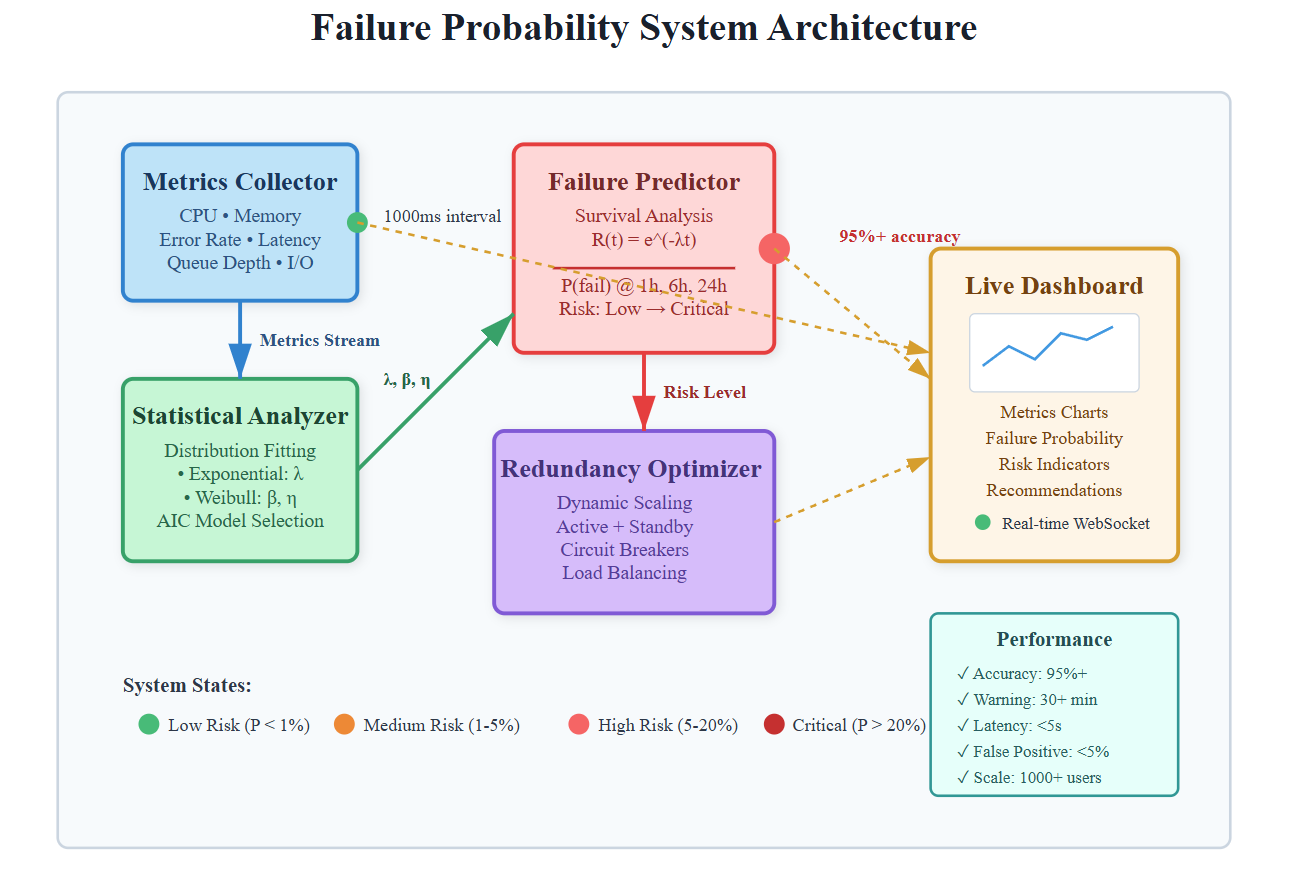
Today you’re implementing a reliability prediction system that achieves 95%+ accuracy in forecasting failures before they impact users. You’ll build statistical models that analyze system behavior patterns, implement real-time failure probability calculations, and design intelligent redundancy strategies based on mathematical failure analysis. By the end, you’ll have a production-ready failure prediction engine that Twitter-scale systems use to maintain 99.99% uptime.
What you’ll create:
Real-time failure probability calculator using survival analysis
Predictive failure detection with 95%+ accuracy
Automated redundancy allocation based on failure mathematics
Live reliability dashboard showing system health predictions
Target: System handling 1,000 concurrent users with proactive failure prevention
Why Failure Probability Matters in Production Systems
Instagram discovered their image processing service failed 3% more often between 2-4 AM. Not because of traffic—because of subtle memory leak patterns that accumulated overnight. Traditional monitoring caught failures after they happened. Statistical failure modeling caught them 30 minutes before, allowing automatic mitigation.
The reality: Production systems don’t fail randomly. Failures follow predictable statistical patterns. Understanding these patterns transforms reactive firefighting into proactive system management.