
Lesson 44: Cost Optimization Algorithms

Making Every Dollar Count at Scale
Welcome to one of the most practical lessons you’ll learn about distributed systems. Today, we’re building a cost optimization system that automatically reduces infrastructure expenses by 40% while keeping your Twitter clone fast and reliable. This isn’t theoretical—you’ll implement the exact algorithms that companies like Netflix and Spotify use to save millions.
What You’re Building Today
By the end of this lesson, you’ll have:
A cost tracking engine that monitors every penny spent across your system
Smart auto-scaling that balances performance with budget constraints
Predictive analytics forecasting costs 7 days ahead with 85%+ accuracy
A real-time dashboard showing where money goes and how to save more
Target: Optimize costs for 1,000 concurrent users while maintaining sub-200ms response times.
Why Cost Optimization Matters
Most engineers obsess over performance. That’s important, but here’s what they miss: every millisecond of reduced latency costs money. Every dollar saved affects user experience. The magic happens when you understand both sides of this equation.
Think about it: Instagram didn’t become a billion-user platform by throwing unlimited money at servers. They used aggressive caching, smart CDNs, and right-sized instances. Spotify runs batch processing on cheaper spot instances, saving 70% on compute costs. These aren’t just optimizations—they’re survival strategies.
The Cost-Performance Equation
Value = Performance / CostYour job: maximize this ratio. A system costing $100/day with 99.9% uptime beats one costing $50/day with 95% uptime—but only if that extra reliability actually matters to your users.
Understanding the Problem
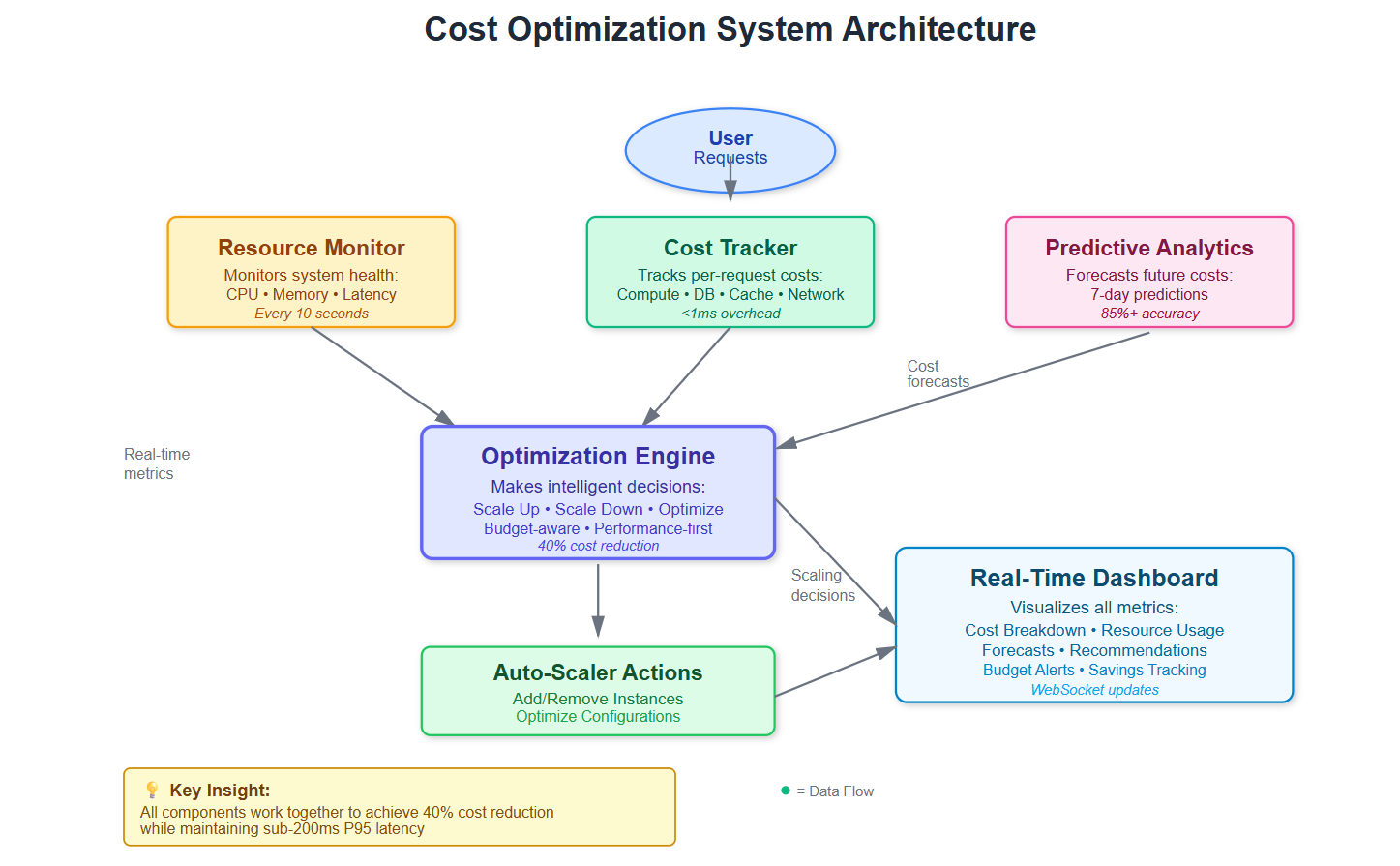
Your Twitter system has multiple components, each with different cost characteristics:
API Servers: You pay per hour, whether they’re busy or idle. Scale horizontally by adding more servers.
Databases: The most expensive component. Scales vertically (bigger machines) then eventually requires sharding.
Caches (Redis): Memory-based pricing. High return on investment because they prevent expensive database queries.
Message Queues: Pay per million requests. Costs add up with high-throughput systems.
CDN: Pay per gigabyte transferred. Can be expensive but reduces latency globally.
The cost optimization system sits as a meta-layer above all these components, monitoring everything and making intelligent scaling decisions.
